The challenges facing spine surgery
Spine surgery still defined by misplaced screws, radiation, lost OR time, and high costs — risks no tool has yet solved.
Why millimeters matter
The pedicle corridor is narrow — just 4–7mm in diameter. A single millimeter off course can mean the difference between a safe placement and serious complications.
Whatever your challenge — patient safety, surgeon safety, learning-curve or surgical efficiency — if it matters to you, we’ve built the solution.
Jump to challenges
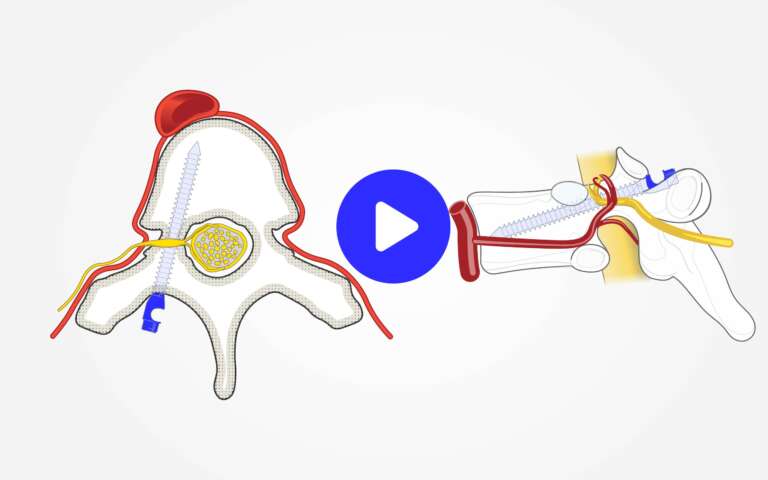
Pedicle screw malalignment
“Do no harm”
Sokrates
But unfortunatly, harm is done on occasion
- Spinal cord injuries and neurological damage
- Major vascular perforations
- Mechanically unstable constructs
- Extended hospital stays and patient suffering
Pedicle screw errors continue to cause avoidable complications and costly revisions – problems patients shouldn’t have to face.
Navigation and robotic systems are not immune; while 90-day revisions for pedicle malalignment for these systems is less than 1%, intraoperative revisions due to misplacement is up to 3%.

intraoperative revisions
due to misplacement even with navigation/robotics
4–6%
of freehand surgeries require a revision
>$2B
per year in extra expense globally
Excessive radiation exposure
Flooding the OR with X-rays and CT scans for screw checks is a dangerous and somewhat dated habit — putting surgeons, staff, and patients at needless risk of radiation damage. Surely, there’s a smarter way…
For OR team:
- Cumulative radiation exposure drives cancer, cataracts, thyroid disease
- Lead aprons are heavy, exhausting
For the patient
- Pediatric patients face higher lifetime risk
Spine surgeons have a
5x
greater cancer risk
Surgeons often exceed lifetime dose limits (e.g. hands, thyroid, whole‑body) even when annual levels appear compliant
Navigation and robotics shift radiation from surgeon to patient.
Intraoperative CT delivers 3–10× higher doses than fluoroscopy — hundreds of chest X-rays in one case.
Staff are safer, but patients, especially the young, face unnecessary long-term cancer risk.
Workflow interruptions
Surgeons face relentless pressure to operate faster, turn cases around quicker, and maximize OR throughput — yet every unnecessary delay makes that impossible.
Technology can disturb workflow…
- Frequent C-arm (or other imaging modalities) repositioning interrupts surgical workflow and may increase risk of infections
- Long set up time of CAS systems wastes OR minutes
- Requires extra staf/technicians where staff shortages are the norm
- Unfavorable ergonomics for surgical team
- One patient shift requires recalibration of CAS systems
OR Time Lost – Calculators
Wasted OR Time – Robot Setup
4–6
hours/month*
The equiavlent of 1–3 extra surgeries per month
* Drape, boot, register, plan, arm positioning (15-25mins) – 4 spine surgeries per week requring precision pedicle screw placement
The last millimeters: The look-ahead challenge
Pedicle screw placement is a game of millimeters. Accuracy in the critical zone before cortical breach is what separates safe, stable fixation from nerve injury, revision surgery, or worse.
Why It’s a Problem
- Freehand techniques: Surgeons rely on feel and fluoroscopy. Neither provides reliable warning in the last millimeters.
- Navigation and Robots: These systems project planned trajectories from pre- or intra-operative imaging. But once the spine shifts, or a reference frame moves, the screen may not reflect reality. They do not sense bone quality in real time—so the critical zone remains blind.
- Dynamic Surgical Guidance (DSG) Technology: The DSG probe listens for changes in electrical conductivity, but only at the tip. That means feedback comes too late—when a breach may already be unavoidable. Signal interpretation can also be inconsistent, especially in bleeding bone or revisions.
Prohibitive capital investment barriers
Navigation and Robotic systems reduce complication rates to between 0.7% and 0.9%; however, they require sizeable upfront investment, and have high annual maintenance costs.
It’s not all roses…
- Prohibitive capital investment costs
- High annual recurring running costs
- Modest absolute risk reduction in relation to costs
- Loss of surgeon autonomy & erosion of surgeon skill
- Radiation trade-offs: less surgeon exposure, much higher patient exposure